Use cases
Is Quovia for a business like yours?
Quovia is built for one kind of sale: high-value technical work, where the proposal carries real detail, the decision is made by more than one person, and what happens after you send it decides whether you win. If that is your world, this is for you.
The common thread
When the proposal is the decision document.
These businesses look different on the surface, but the sale rhymes: a detailed, technical proposal goes out, it gets reviewed by several people internally, and the rep loses sight of it at exactly the moment it matters most. Quovia is built for that shape of deal.
Engineering
Engineering companies
The problem: your proposal carries real engineering detail, equipment, ratings, and scope that have to be exactly right. It goes to a project lead who shares it with colleagues you never meet.
After the send: you are guessing whether the spec landed, who raised a concern, and when to follow up without nagging.
Why Quovia fits: it keeps the technical detail accurate inside the proposal and shows you who opened it, who re-opened it, and which sections held attention, so follow-up is informed, not blind.
Building services
M&E and building-services contractors
The problem: your proposals run to multiple trades and a long scope of works, often into a main contractor or a client's project team.
After the send: it gets forwarded around procurement, the QS, and operations. You rarely know it reached the people who actually sign off.
Why Quovia fits: it shows you when a proposal reaches more than one stakeholder and where the attention goes, on price, scope, or programme, so you follow up with the right person at the right moment.
Equipment & plant
Industrial equipment, plant, and infrastructure sales
The problem: you sell high-value equipment and installation, where the model, rating, and figures must be exactly right and a single wrong spec can sink the deal.
After the send: the decision is made by a committee over weeks, and a silent fortnight can mean a lost order with no clear reason why.
Why Quovia fits: it builds the equipment specifications into the proposal itself, so clients never get the wrong detail, and gives you the post-send signals to keep a slow, multi-week decision moving.
Technical services
Technical service businesses selling complex scopes
The problem: you sell service contracts and complex scopes of work where the proposal is the decision document, not a formality.
After the send: it is reviewed internally, compared against others, and sat on. From the outside, a stalled deal and a live one look identical.
Why Quovia fits: it shows you the engagement after send, so you can tell a live deal from a dead one and follow up on signal rather than a generic three-day timer.
What you would see
The same engagement view, whatever you sell.
Across all of these, the value is the same: after you send, you can see opens, re-opens, multiple viewers across a buying group, and which sections hold attention. That is what turns a blind follow-up into an informed one.
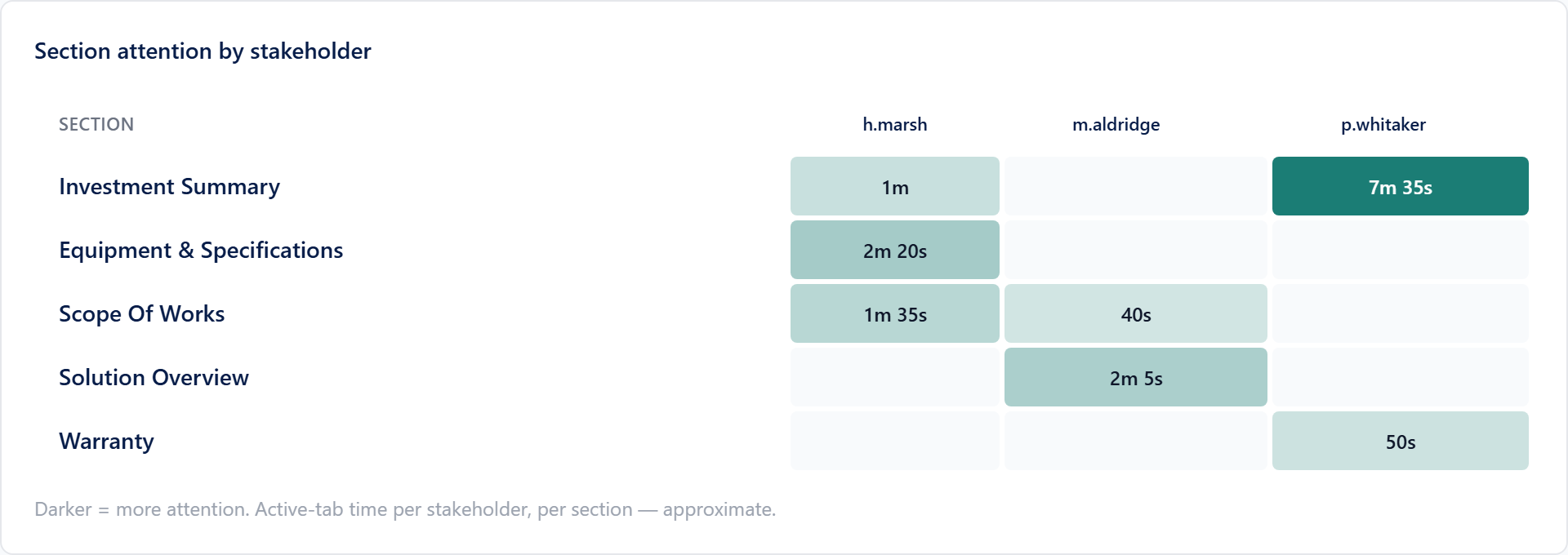
Live engagement view. Demonstration data.
Where it is not the fit
Quovia is deliberately narrow.
It is less suited to high-volume transactional quoting or simple one-page estimates, where there is no multi-stakeholder review and little to follow up on. We would rather be the obvious choice for technical, proposal-led sales than a vague fit for everyone.
See it on your own deals
See Quovia on a proposal like yours.
Book a short walkthrough and we will show it on a proposal that looks like your work, or read how it compares to how you send proposals now.